




IMDEA Nanociencia researchers join efforts to establish an open databank for atomic force microscopy: the bioAFM-DB
01.10.2026
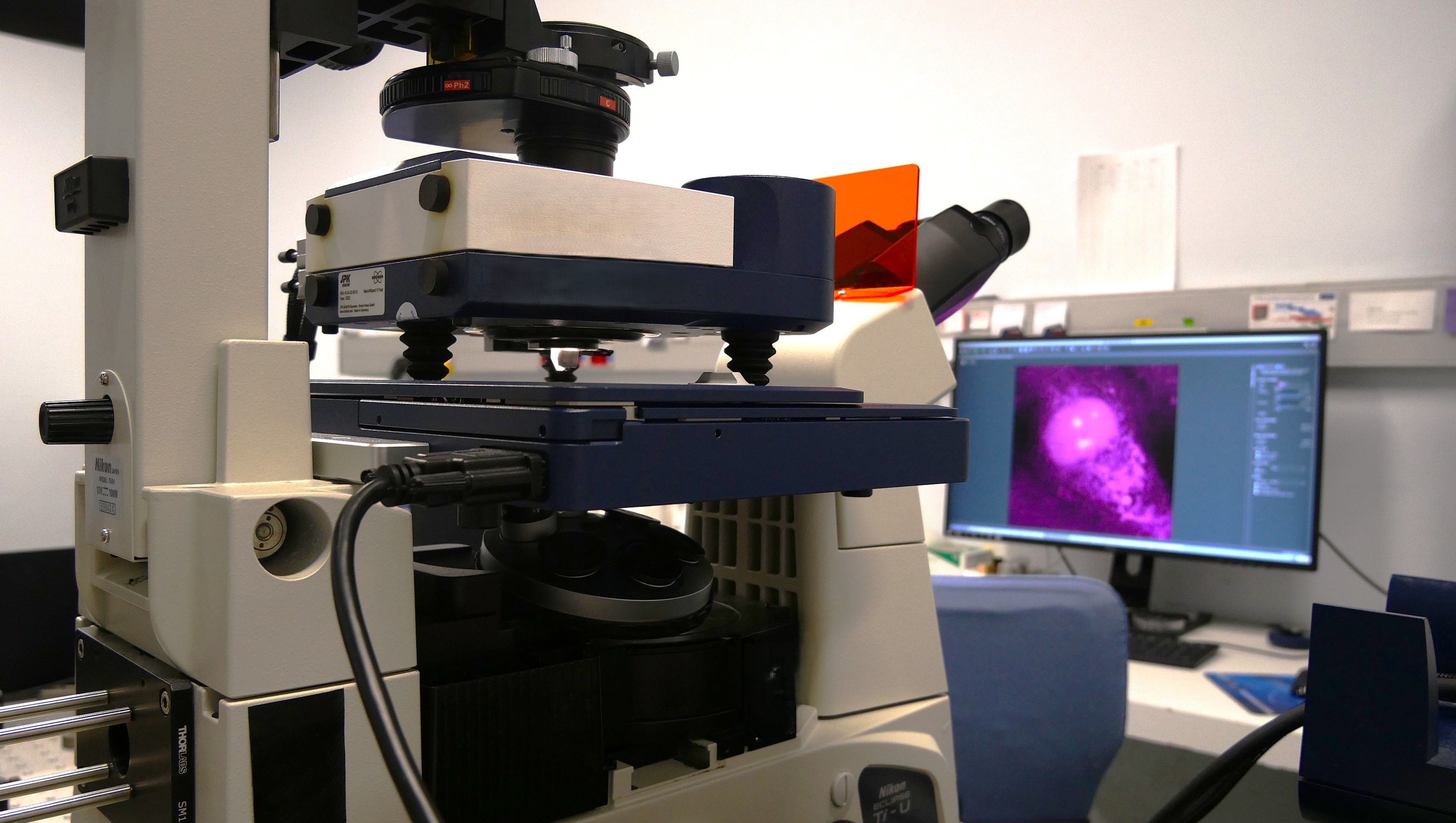
AFM microscope at IMDEA Nanociencia.
- The AFM Service at IMDEA Nanociencia will participate in the establishment of a high-quality databank of AFM data.
- A comment, published in Nature Methods, outlines the challenges and potential courses of the endeavour.
| Tweet |  |
Press release download |
Madrid, 1st October 2026. Open scientific data are essential for advancing research. By allowing researchers to access, reuse and build on data beyond the study for which they were originally generated, public repositories can improve reproducibility and accelerate new discoveries. A well-established example is the Protein Data Bank (PDB), created in 1971 as a public repository for experimentally determined molecular structures. Its data are now used by millions of researchers and by hundreds of other scientific resources, and have contributed to developments that extend well beyond the original purposes for which the data were collected, including computational approaches to protein structure prediction.
In this context, Cristina Flors and Patricia Pedraz from the AFM service at IMDEA Nanociencia will contribute to the effort to make Atomic Force Microscopy (AFM) data more accessible and reusable. This contribution goes beyond data deposition: the service is also participating in the ongoing discussion about how AFM data should be presented, structured and described so that they can be understood and reused by researchers beyond the laboratories in which they were generated.
The challenge is significant. There is currently no dedicated repository for Scanning Probe Microscopy (SPM) data. The authors of the manifesto argue that the time is right to develop one, as AFM has reached a level of maturity and widespread use that was not the case two decades ago. However, AFM data are currently generated by instruments from different manufacturers and models, often using proprietary or incompatible formats. As a result, data may require conversion before they can be deposited in a repository, and appropriate software is needed to read and process them. The challenge is therefore not only to agree on common formats and metadata standards, but also to develop interoperable tools capable of reading, converting and analysing AFM data. The article identifies agreement on a common AFM data-exchange format as an important task for the community.
This Open Science initiative is still at a very early stage. Led by Jean-Luc Pellequer of Université Grenoble Alpes and Claire Valotteau from Aix-Marseille University, it has already brought together 118 researchers from 107 research centres and institutions across 26 countries: Australia, Austria, Belgium, Canada, Chile, China, Croatia, Cyprus, the Czech Republic, Denmark, France, Germany, Hungary, India, Italy, Japan, Kazakhstan, the Netherlands, Norway, Poland, Portugal, Russia, Spain, Switzerland, the United Kingdom and the United States. In Spain, researchers from UAM, CSIC/UPV-EHU, ICMM-CSIC, Universitat de Barcelona, IBEC, CNB-CSIC and IMDEA Nanociencia signed the initiative. The discussion emerged within the AFM community in connection with the AFM data symposium held alongside the AFMBioMed conference in Barcelona in April 2025, where a group of volunteers began working on AFM metadata, initially addressing areas including the sample, cantilever, experimental conditions, recording parameters and data. The initiative is now exploring the foundations of a potential bioAFM databank, with the European Bioinformatics Institute (EBI) of EMBL supporting the preliminary metadata work and the possibility of future integration into its infrastructure. The immediate focus would be on three types of AFM data: topography, spectroscopy and nanomechanics.
Reference:
Pellequer, JL., Aguayo, S., Alessandrini, A. et al. A FAIR road to a bioAFM databank. Nat Methods (2026). https://doi.org/10.1038/s41592-026-03214-7
Link to preprint at IMDEA Nanociencia Repository: https://hdl.handle.net/20.500.12614/4288
Contact:
Cristina Flors
This email address is being protected from spambots. You need JavaScript enabled to view it.
Advanced Fluorescence Nanoscopy Group
https://nanociencia.imdea.org/advanced-fluorescence-nanoscopy/group-home
AFM Service Scientific Coordinator
https://nanociencia.imdea.org/services/laboratories/microscopia-de-fuerza-atomica-afm
IMDEA Nanociencia Dissemination and Communication Office


Source: IMDEA Nanociencia.
IMDEA Nanociencia Institute is a young interdisciplinary research Centre in Madrid (Spain) dedicated to the exploration of nanoscience and the development of applications of nanotechnology in connection with innovative industries.